
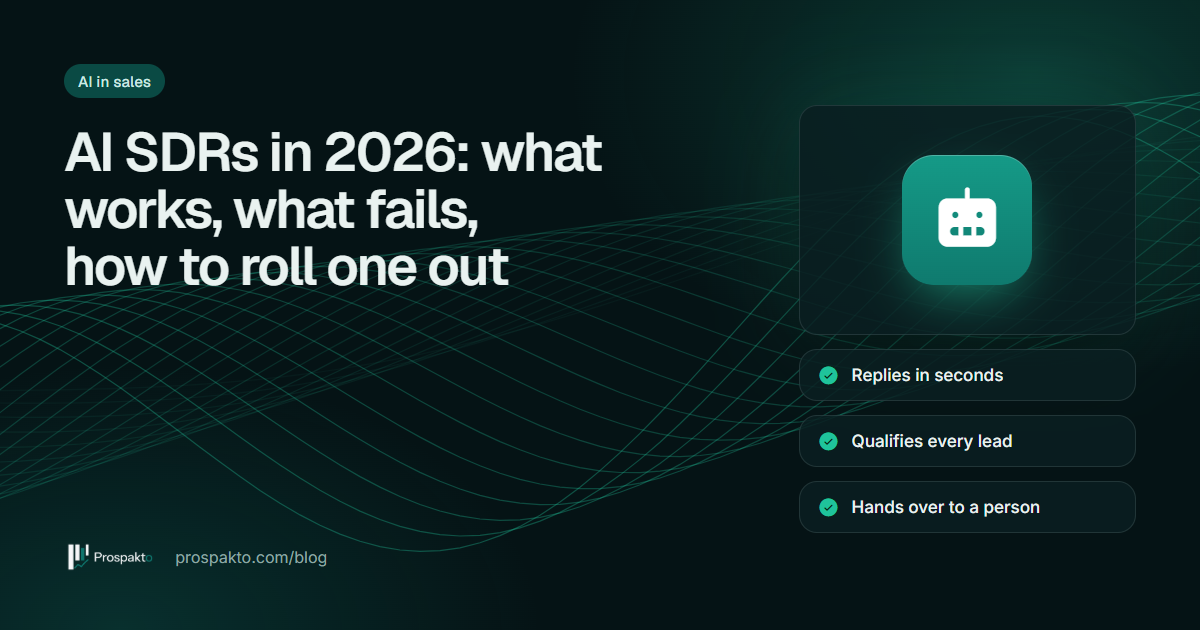
An AI SDR is software that does the early, repetitive part of a sales development rep's job. It answers new leads, asks qualifying questions, books the next step and hands warm conversations to a person. In 2026 it has stopped being a novelty. The harder question for most teams is how to deploy one without annoying good prospects.
Where adoption stands
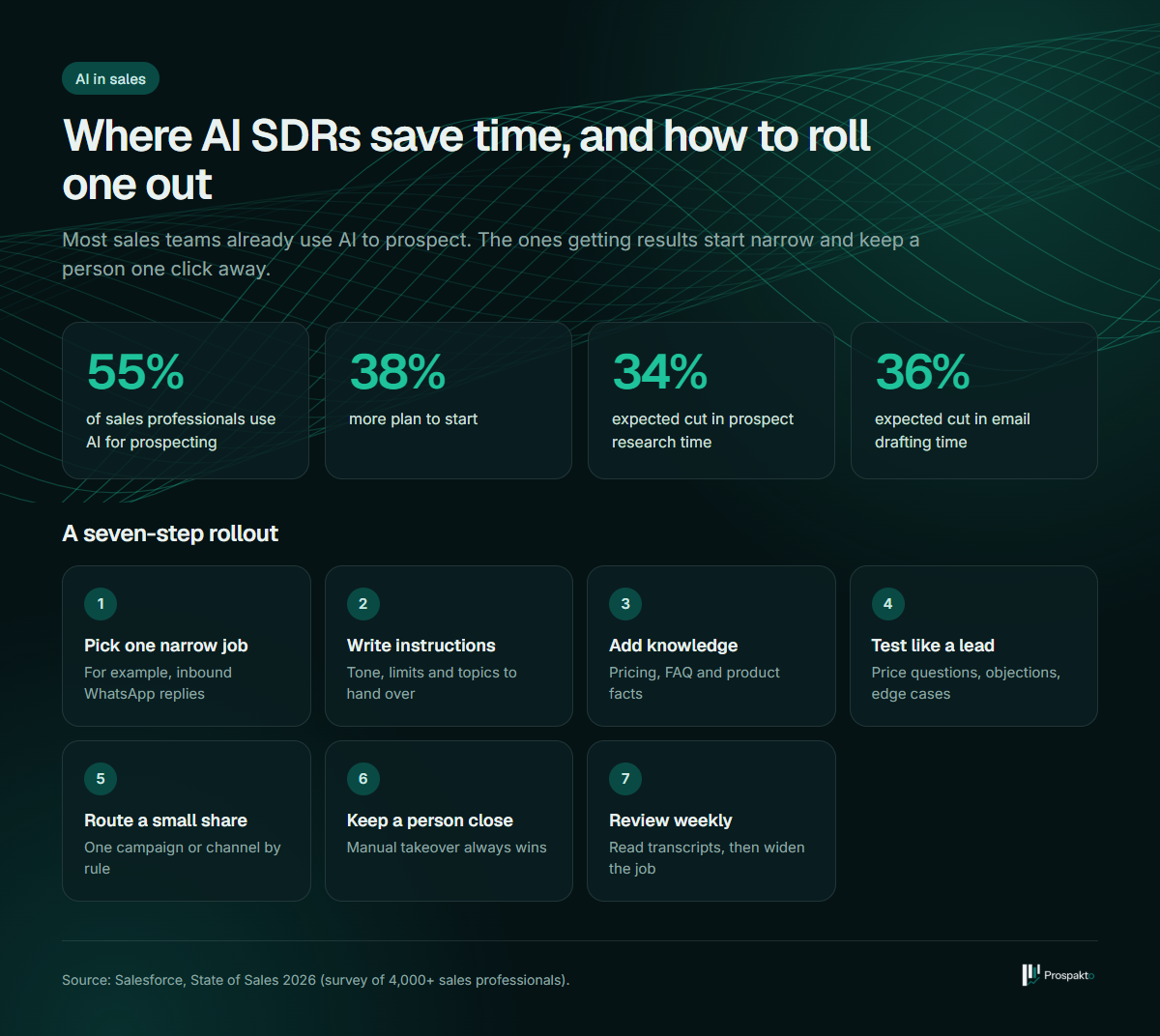
Salesforce's 2026 State of Sales survey of more than 4,000 sales professionals found that 55% already use AI for prospecting, and another 38% plan to. Sellers in the same survey expect fully deployed agents to cut prospect research time by 34% and email drafting by 36% (Salesforce).
The time matters because selling is still a minority of the job. The same report puts the average seller's time spent actually selling at 40%. The rest goes to research, data entry and admin, which is the work an agent can absorb.
Gartner's research points the same way from the seller's side. In a 2024 survey of 1,026 B2B sellers, those who partnered effectively with AI tools were 3.7 times more likely to meet quota (Gartner). That is a correlation from self-reported data, so treat it as a signal, not a promise.
What an AI SDR does well
The best jobs for an AI agent are high in volume, time-sensitive and easy to check.
- Answering inbound leads at any hour. A lead who fills in a form at 11 pm gets a reply in seconds instead of the next morning. The post on speed to lead covers why that matters.
- Catching up on a backlog. When leads are reassigned, an agent can answer every message that is already waiting.
- First-round qualification. Budget, timing, role and fit are questions an agent can ask the same way every time.
- Keeping the record. Every message and call lands on the lead's timeline with a transcript, so the rep who takes over starts with context.
Where AI SDR pilots go wrong
Most failures come from giving the agent too much freedom too early.
The first problem is weak instructions. An agent told to "be helpful and book meetings" will improvise pricing, promise features and chase people who already said no. The second is thin knowledge. If the agent can't look up your pricing page or product facts, it guesses. The third is no handover. Buyers still want a person at the moments that matter: Gartner found in May 2026 that 69% of B2B buyers turn to sales reps to validate AI-generated insights (Gartner).
The last problem is that nobody reviews the output. If no one reads what the agent says for the first few weeks, small mistakes repeat thousands of times.
A rollout plan that works
1. Pick one narrow job
Start with inbound replies on one channel, such as WhatsApp leads from your website. Leave outbound calling and complex deals for later.
2. Write instructions like a job description
Cover who the agent is, what you sell, how it should speak, what it must never say, and which topics go to a person. In Prospakto this is the agent's instructions field. The steps are in Create an AI agent.
3. Give it facts to work from
Add your pricing page, FAQ and product sheets as knowledge sources, and connect a data source if the agent needs live answers. See Teach an AI agent with knowledge sources.
4. Test it like a lead would
Ask about price. Push back. Ask for something it shouldn't promise. Prospakto's Test mode lets you chat with an agent without sending anything to a real lead (how to test).
5. Route a small share of leads to it
Use an assignment rule so only one campaign or channel goes to the agent. Everyone else keeps their usual owner. See Create assignment rules.
6. Keep a person one click away
Any conversation should switch back to a human instantly. In Prospakto, setting a conversation to Manual stops the agent at once, and a person taking over always wins (Manual and Auto-pilot).
7. Review the conversations every week
Read a sample of transcripts and the AI's verdicts. Fix instructions, add missing knowledge, and widen the agent's job only when the results hold.
What to measure
| Metric | Why it matters |
|---|---|
| Time to first reply | The main reason to use an agent at all |
| Share of conversations handed to a person | Too low can mean the agent is overreaching. Too high means it isn't helping |
| Qualified rate of agent-handled leads | Compare it with leads handled by people |
| Complaints and opt-outs | The early warning that tone or targeting is off |
| AI cost per qualified lead | Keeps the business case honest. Prospakto shows this under AI Spend |
Where Prospakto fits
Prospakto puts AI agents and your sales team in the same workspace. Agents reply on WhatsApp and email, answer and make calls, and hand over to a person when asked. Every conversation gets the same AI review as a human one, so you can compare results side by side. Read more on the Engage page, or see how AI voice agents handle inbound calls.