

A prospect who calls you is about as warm as a lead gets. They chose the most direct channel, and they expect an answer now. When nobody picks up, many won't leave a voicemail. They call the next company on their list.
AI voice agents can now hold a natural phone conversation, look things up and transfer to a person. Used well, they make sure every caller is answered. Used badly, they trap people in a loop with a robot. The difference is almost entirely in the setup.
Three routing patterns
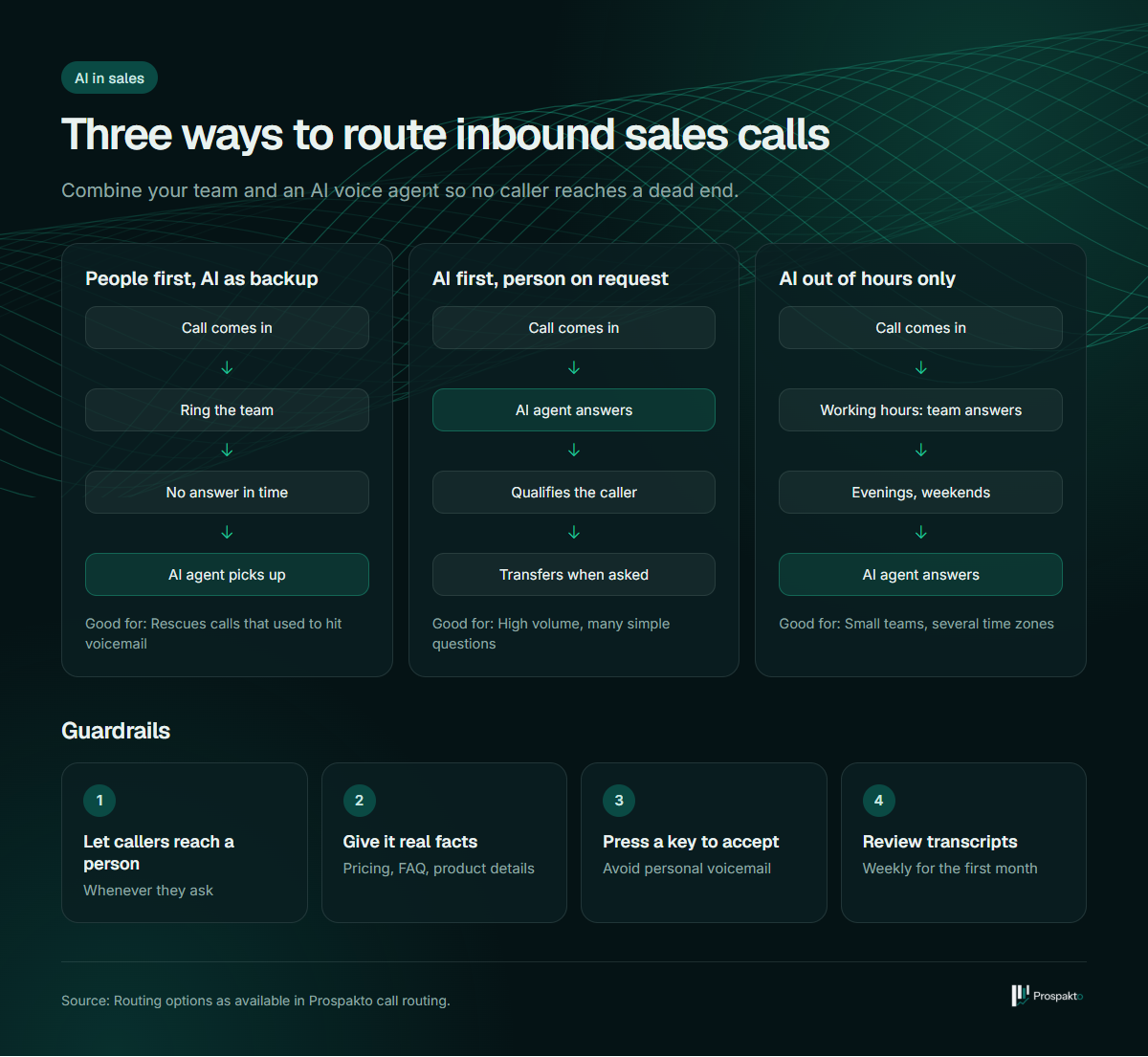
There are three common ways to combine people and an AI agent on an inbound line.
| Pattern | How it works | Good for |
|---|---|---|
| People first, AI as backup | Ring the team. If nobody answers in time, the AI agent picks up | Teams that want a human on every call they can manage |
| AI first, person on request | The AI agent answers, qualifies and transfers when the caller asks or the call needs it | High call volume, many simple questions |
| AI out of hours only | People answer during working hours. The AI agent covers evenings and weekends | Small teams, callers in several time zones |
Most sales teams start with "people first, AI as backup". It changes nothing for callers who reach a person, and it rescues the calls that used to hit voicemail.
Setting it up in Prospakto
1. Decide who answers first
For each voice number, choose whether an AI agent or a person answers first. If the AI answers, it can hand the call to a person when the caller asks. See Set up call routing.
2. Define the ring steps
Choose who to ring and in what order: the lead's owner, anyone available, a specific colleague, or another number. Ring them one at a time or all at once, for 5 to 60 seconds per step.
3. Turn on "press a key to accept"
This stops a rep's switched-off mobile from sending your caller to their personal voicemail.
4. Choose what happens when nobody answers
Hand the call to the AI agent, take a voicemail, or play a message. Handing to the agent is usually the best option for sales lines.
5. Write the agent's instructions for voice
Phone conversations need shorter sentences than chat. Tell the agent which questions to ask, what it can and can't say about price, and when to transfer. The steps are in Create an AI agent.
Guardrails that keep callers happy
- Let callers reach a person whenever they ask.
- Give the agent real knowledge to work from: pricing, FAQ, product details. An agent that has to guess will guess wrong.
- Tell callers when a call is recorded, where the law requires it.
- Keep the agent's job narrow at first: answer, qualify, book or transfer.
During a call, a Prospakto agent can update the lead's stage, take notes, record details like email and company, send a follow-up message and transfer the call. Every call is recorded and transcribed on the lead's timeline (what agents do).
What to measure
| Metric | What it tells you |
|---|---|
| Share of inbound calls answered | The main reason to add an agent |
| Calls transferred to a person | Whether the agent hands over at the right moments |
| Qualified leads from agent-answered calls | Whether the agent's questions work |
| Call mood | Prospakto rates each call positive, neutral, negative or alarming. A rise in negative calls is the first sign of trouble |
Read a sample of transcripts every week for the first month. The AI insights on each call make this faster, because each one comes with a summary, verdict and recommended next step (AI insights).
Outbound calls too
The same agent can make outbound calls when a rep clicks Voice agent on a lead, and leaves a short voicemail if an answering machine picks up. For a wider view of where AI fits in sales development, read AI SDRs in 2026, or see voice agents on the Engage page.