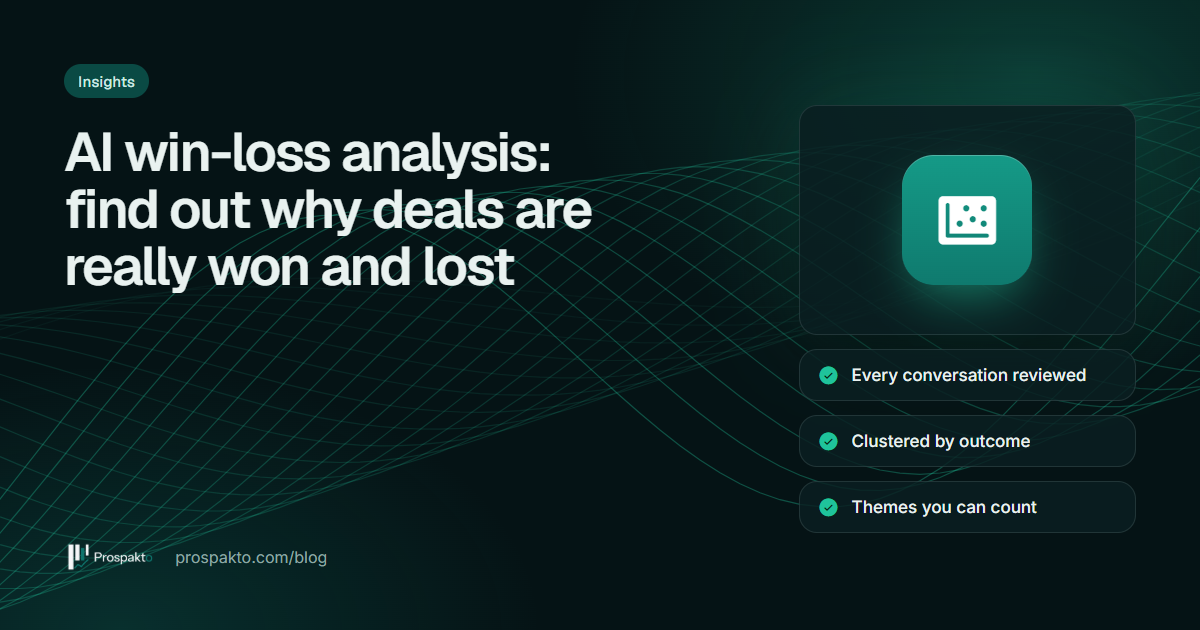
Win-loss analysis asks a simple question: why did we win this deal, and why did we lose that one? Most teams answer it with a dropdown in the CRM. A rep closes a deal as lost and picks "price" or "timing" from a list. Months later, leadership looks at a chart that says most deals are lost on price.
That chart is rarely the whole story. "Price" is often what a buyer says when the real problem was a missing feature, a competitor's better demo, or a champion who left. The detail that explains the loss is in the calls and messages, and until recently nobody had time to read them all.
How AI changes win-loss analysis
AI can review every conversation the same way. For each call or thread it can record a verdict, the reasons behind it, the objections raised and the product strengths and weaknesses mentioned. Once every conversation has the same structured review, you can group and count them.
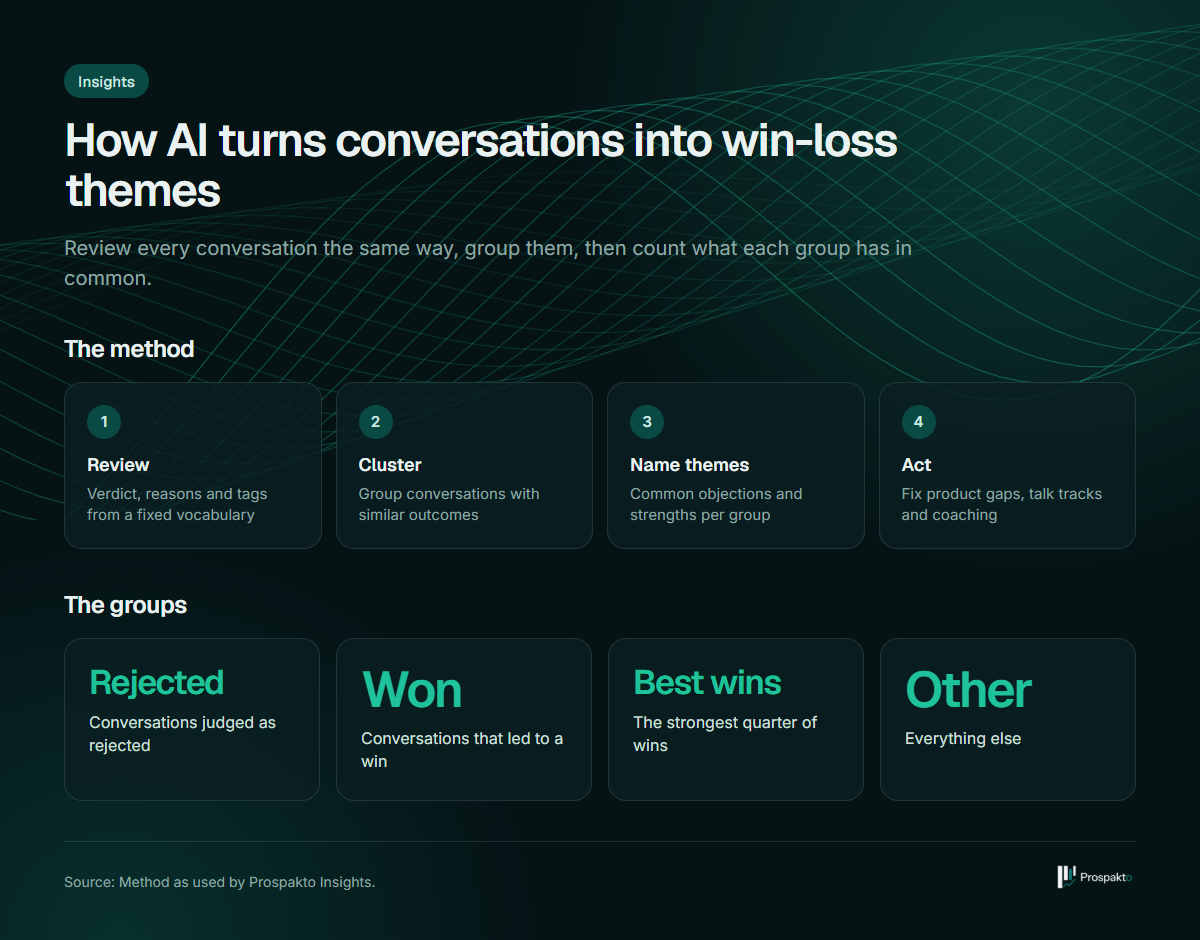
The method has three steps.
- Review every conversation the same way. Each one gets a verdict and tags from a fixed vocabulary, so "too expensive" and "over budget" count as the same thing.
- Group similar conversations. Clustering puts conversations with similar outcomes and themes together.
- Name the themes in each group, so the common objections in lost deals and the common strengths in won deals can be counted.
Why a fixed vocabulary matters
If an AI describes each conversation in free text, you get hundreds of slightly different phrases that can't be counted. A fixed list of terms for product strengths, weaknesses and rep behaviours keeps the tags consistent.
In Prospakto this is the AI vocabulary. Each company starts with a ready-made list. When nothing fits, the AI can propose up to 3 new terms per review, marked so an admin can accept, rename or merge them.
Running a win-loss analysis in Prospakto
Make sure conversations are reviewed
Prospakto reviews conversations on its own when a call transcript arrives or a conversation closes. To refresh a whole campaign, Managers can run AI qualification.
Run clustering
Open Insights, choose all campaigns or one, and click Run clustering. Prospakto groups conversations into rejected, won, best wins (the strongest quarter of wins) and other, then names the common themes in each group (how Insights works).
Read the top rejection reason, then check it
Insights shows your overall win rate and the top reason for rejection. Click into the dots on the map to open real conversations and confirm the pattern holds.
Compare by channel, feature and rep
The same objection might be common on WhatsApp but rare on calls, or common for one rep and rare for another. That tells you whether to fix the product, the pitch or the coaching.
Save it and track it over time
A Pattern report saves a copy of a company-wide run. Sales, Campaign and Product insight reports show win rate, reach and top win and loss reasons over time (report types).
Questions a good win-loss analysis answers
| Question | Where the answer comes from |
|---|---|
| What is the most common reason we lose? | Top rejection reason across the rejected group |
| What do our best wins have in common? | Themes in the best-wins group |
| Which product gap costs us most? | Product weaknesses counted across lost deals |
| Is a loss reason a product problem or a coaching problem? | The same reason compared across reps |
| Is it getting better? | Insight reports by week or month |
Turning findings into action
Share the top two loss themes with product and marketing. Turn the best-win themes into talk tracks. Then use the rep-level comparison to coach. Our post on AI sales coaching covers that last step. To see the reporting side of Prospakto, visit the Intelligence page.