

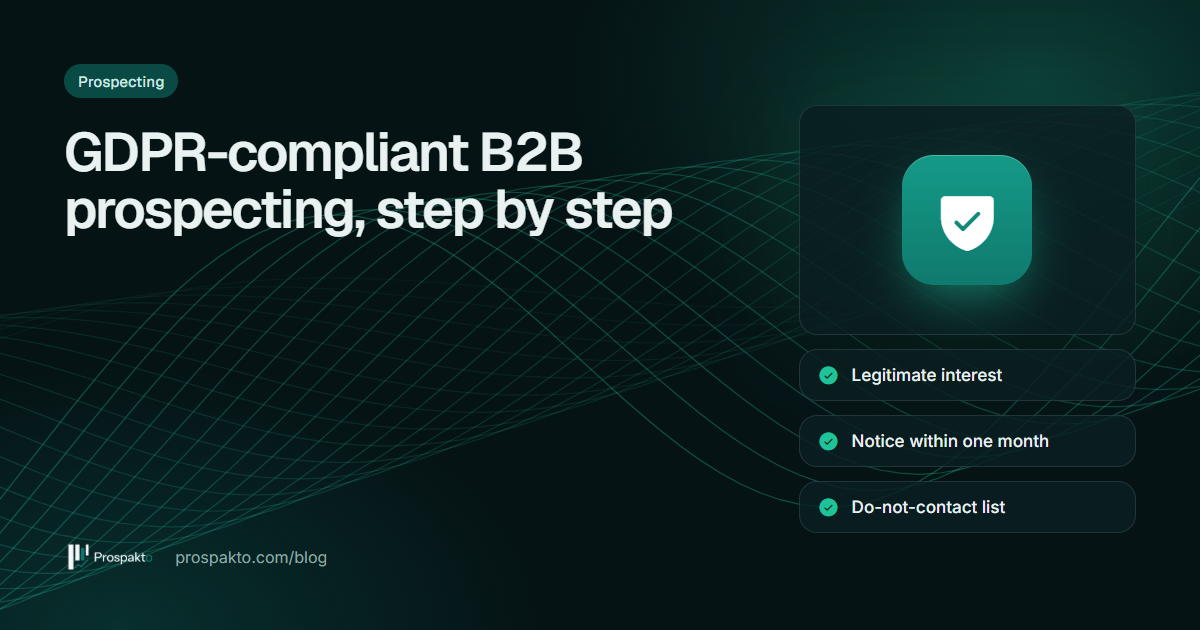
If you sell into the UK or the EU, the people you prospect are protected by data protection law, even when you only hold their work email. GDPR, and the UK's version of it, doesn't forbid finding and contacting new prospects. It does set rules about how you do it.
The lawful basis: legitimate interest
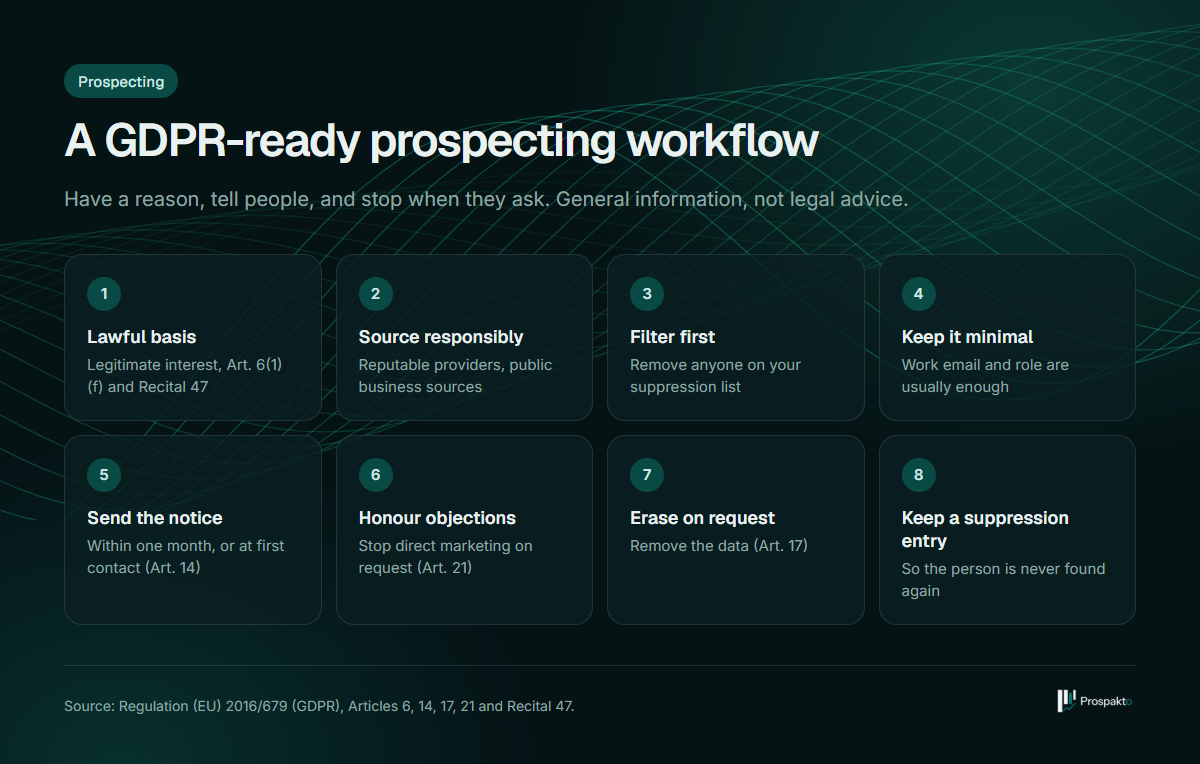
Every use of personal data needs a lawful basis. For B2B prospecting, most companies rely on legitimate interest under Article 6(1)(f). Recital 47 of the GDPR says processing for direct marketing purposes may be regarded as carried out for a legitimate interest (GDPR Recital 47).
Legitimate interest is not automatic. You need to weigh your interest against the person's rights and expectations. Contacting a head of procurement about procurement software is easy to justify. Collecting personal phone numbers of junior staff is much harder.
Tell people you hold their data
When you collect personal data from somewhere other than the person, such as a website, directory or data provider, Article 14 requires you to give them certain information. That includes who you are, why you hold their data, where it came from and their rights. You must do this within a reasonable period, and at the latest within one month, or at the first communication if you contact them sooner (GDPR Article 14).
Many sales teams handle this badly because nobody owns the deadline. A prospect added in a busy week is forgotten until it's too late.
Stop when people object
Under Article 21, a person can object to processing for direct marketing at any time, and you must then stop processing their data for that purpose (GDPR Article 21). They can also ask you to erase their data under Article 17.
The tricky part comes afterwards. If you delete someone completely, your next research run or list import can find them again. That's why most teams keep a suppression list: a minimal record that says "never contact this person", used to filter future searches and imports.
A compliant prospecting workflow
| Step | What to do |
|---|---|
| Define your audience | Target roles that have a clear business reason to hear from you |
| Source responsibly | Use reputable data providers and public business sources. Respect websites that ask not to be crawled |
| Filter before you add | Remove anyone on your suppression list before they become a lead |
| Keep only what you need | Work email and role are usually enough. Avoid personal contact details |
| Send the notice | Within one month of collecting the data, or at first contact |
| Honour objections everywhere | Block the channel, and add the person to the suppression list |
| Erase on request | Remove everything, keep only the suppression entry |
How Prospakto handles this
Prospakto's research tools cover several of these steps.
- The AI researcher never visits social networks such as LinkedIn or Facebook, and it respects websites that ask not to be visited (how research works).
- Every fact in a lead dossier links to the source page it came from, and facts without a real source are left out.
- The do-not-contact list stores only a scrambled fingerprint of an email, phone number or company website, never the address itself, and filters it out of every future search.
- Erase a person removes everything research holds on someone at once and adds them to the do-not-contact list unless you choose otherwise.
- The notice log creates a reminder for each person added through research and flags overdue ones. Admins mark each as sent, not required or waived.
The admin steps are in Research privacy and compliance. For Prospakto's own data protection practices, see our Security and Privacy pages.
Related reading
Compliant sourcing also improves deliverability, because people who expect to hear from you rarely mark you as spam. See cold email deliverability in 2026 for the sender rules, or WhatsApp for B2B sales if your buyers prefer messaging.